
Crafting the Cup: The Botanical Story Behind Evening Garden, an Herbal Tisane Blend

The Evening Ritual: Settling In
There is a beautiful shift that takes place in a garden as daylight fades.
The pace slows. The air cools. Some flowers that opened themselves fully to the sun begin to close their petals. Leaves settle. The garden seems to draw inward.
This natural circadian movement is called nyctinasty—the closing of flower petals and folding of leaves in response to the onset of darkness. For the plant, this rhythmic movement serves practical purposes, including protection and conservation.
This natural rhythm of the garden inspired the feeling I wanted to capture in Evening Garden Loose Leaf Tisane—the gentle transition from the fullness of the day to the comfort of evening.
It's a feeling of settling in. Of coming home to yourself after a day spent moving through the world.
A warm cup in your hands. The aroma rising from the steam. A few unhurried breaths. The simple act of sitting still for a moment.
The organic herbs in this tea blend—chamomile, linden, hawthorn, tulsi, rose, and lavender—each bring their own history and character to the cup. Collectively, their stories seeded an evening ritual centered on slowing down, finding comfort, making a little space for yourself, and taking a moment to settle in.

Chamomile (Matricaria recutita): The Little Flower That Bows with the Light
Chamomile has been part of traditional herbal practices for centuries. Its name comes from the Greek chamaimēlon, often translated as “earth apple,” a fitting name for a small flower with a distinctly sweet, apple-like fragrance.
Chamomile has been valued in traditional herbalism for its gentle, soothing character. Historically, it has been used in preparations associated with relaxation and with settling the digestive system after a meal.
There is something especially fitting about chamomile having a place in Evening Garden.
Chamomile forms the foundation of this blend, present in greater proportion than any of the other herbs. And of all the flowers in the tisane, chamomile is the one that participates in the evening transition described in the opening.
As darkness approaches, chamomile flower heads naturally bow downward in a circadian movement called nyctinasty. This rhythmic response to changing light is part of the flower's natural daily cycle.
There is something quietly beautiful about this gesture. As the light fades, the flower no longer holds itself upright toward the day. It bows, as though acknowledging that the time for reaching outward is giving way to something quieter.
Chamomile reminds us that there is a time to be fully engaged with the world—and a time to ease out of the day's activity.
In Evening Garden, chamomile represents this gentle transition: from outward activity toward quiet, from the fullness of the day toward the comfort of evening.
Linden (Tilia spp.): A Gentle Invitation to Soften
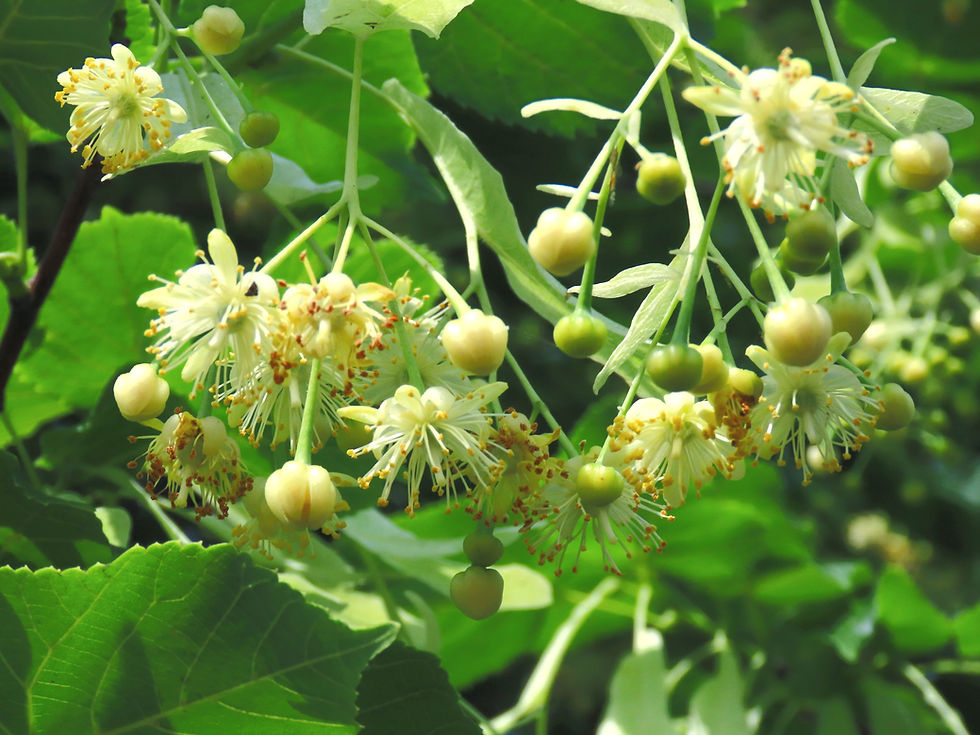
Linden trees have a long and beautiful cultural history, particularly throughout Europe. Their heart-shaped leaves and fragrant blossoms have made them beloved shade trees and subjects of folklore.
In traditional European herbalism, linden flowers have long been used as an infusion during times of nervous tension and restlessness. Traditional herbal practices also associate linden with gentle relaxation and evening rest.
The delicate floral sweetness of linden flower and leaf brings a soft, rounded quality to Evening Garden, gently balancing the astringent notes of some of the other botanicals and bringing the flavors together in harmony.
For Evening Garden, linden represents the gentle release of a busy day.
It is the botanical equivalent of loosening your grip, taking a deep breath, and allowing yourself to become a little less guarded, a little less hurried, and more at ease.
Hawthorn Flower and Leaf (Crataegus spp.): A Symbol of Protection
Hawthorn carries some of the richest folklore of all the plants in this blend.
Throughout European traditions, the hawthorn tree has been associated with protection, boundaries, love, and the heart. Hawthorn leaves and flowers have also been valued in traditional herbalism and used in preparations associated with the heart, nervous tension, mental stress, and rest.
For centuries, hawthorn has carried the symbolism of protection, creating a sense of shelter and safe boundaries while remaining rooted in the world around it. Delicate flowers and leaves grow among dense, thorny branches—a natural boundary between what is inside and what is outside.
That sense of shelter is what makes hawthorn especially meaningful in Evening Garden. The heart needs a protected place to rest, too.
In this blend, hawthorn leaves and flowers are a reminder that an evening ritual can be about more than sleep. It can be about creating a little space between ourselves and the demands of the day—a natural boundary where we can turn inward, soften, and let the world wait until tomorrow.
Tulsi (Ocimum tenuiflorum): The Sacred Herb of Balance

In India, tulsi—also called holy basil—has been revered for thousands of years and holds an important place in Ayurvedic tradition. Tulsi has been regarded as a sacred plant associated with protection, devotion, clarity, harmony, and well-being.
In Ayurvedic tradition, tulsi has been called the “Mother Medicine of Nature” and the “Queen of Herbs.” It has long been valued as an herb of resilience and vitality. It is considered an important adaptogen, helping the body adapt to life's challenges and stressors.
That makes tulsi an especially meaningful companion for an evening ritual.
After a day spent moving outward into the world, evening offers an opportunity to return to a more centered place. Tulsi represents that sense of balance—the gentle meeting point between activity and rest, outward attention and inward reflection.
Rather than signaling that the day is simply over, tulsi can remind us to come back to ourselves with a little more clarity, harmony, and intention—a return to yourself after a day spent moving outward into the world.
Rose (Rosa spp.): A Flower of the Heart
Few flowers carry as much emotional meaning as the rose.
Across cultures and centuries, roses have been associated with love, beauty, comfort, celebration, grief, and remembrance. Rose petals have also been used traditionally in herbal preparations associated with the heart and emotional well-being.
And like life itself, the flavor of rose can be sweet, bitter, and astringent. Perhaps that is part of its beauty. It reminds us that life holds many different experiences—and that we can still choose to open our hearts to love, including love for ourselves.
But perhaps the most beautiful thing rose contributes to Evening Garden is simply its presence. Beauty has a place in an evening ritual.
Sometimes we don't need another instruction or another thing to accomplish. Sometimes we simply need a moment to appreciate something for the beauty it brings to our day.
Rose invites us to slow down, soften, and remember that tending to ourselves can be as simple as making space for beauty.
Lavender (Lavandula angustifolia): The Scent of Letting Go
For centuries, lavender has been treasured for its fragrance and calming qualities and used traditionally in herbal practices associated with relaxation, rest, and easing tension. It has also been valued during times of stress and emotional strain.
Lavender carries a deeper traditional meaning as well. It has been associated with courage and strength—qualities needed to face difficult or stressful moments with a steady heart and mind. In this way, lavender is not simply about becoming quiet or still. It is about finding a sense of calm from which we can gather ourselves and let go of the tension we have been carrying.
In Evening Garden, just a hint of lavender is added, allowing its distinctive floral aroma and flavor to remain subtle. Sometimes, we don't need a lot of one thing. A little can be enough to make its presence known without overwhelming everything around it.
In Evening Garden, lavender represents letting go.
As the day comes to an end, its presence offers a gentle reminder that we don't have to carry everything forward. Sometimes, letting go is its own kind of strength.
Evening Garden Herbal Tisane Blend:
Six Herbs, One Evening Ritual
Each herb in Evening Garden has its own history and personality.
Chamomile brings comfort and reminds us of our innate natural rhythm.
Linden invites us to soften and release the busyness of the day.
Hawthorn offers a sense of protection and a safe place to rest.
Tulsi brings resilience, balance, and a return to ourselves.
Rose brings beauty and reminds us to make space for what nourishes the heart.
Lavender invites us to let go and find the quiet strength that comes with rest.
But the beauty of the blend isn't necessarily in what any single herb can do.
It is in the way their stories come together.
Together, these six botanicals create an evening ritual that is less about what the herbs are expected to do and more about the experience of slowing down, turning inward, and making space for yourself for.
That is the garden I imagined when I created the herbal tisane blend, Evening Garden.

Brewing the Herbal Tea Blend
The Measurement:
Use 1.5 teaspoons (approximately 1 gram) of loose tisane per 8 ounces of water.
The Water:
Bring fresh water to approximately 185–195°F.
The Steep:
Pour the water over the herbs and steep for 12–15 minutes. If your kettle reaches a full boil, simply let the water rest a minute before pouring.
Extend the ritual: A Second Steep:
The herbs can be steeped a second time for another cup. The second infusion will be lighter. Enjoy Evening Garden warm or chilled, depending on the season or your mood. Add a hint of honey if desired.
A Note About the Herbs
The plants in Evening Garden have long histories of use in traditional herbal practices and cultural traditions. The descriptions in this article refer to those traditional uses and historical associations; they are not intended as claims that the tisane treats, prevents, or cures any medical condition.
As with any herbal product, individual herbs may not be appropriate for everyone. If you are pregnant or nursing, have a medical condition, take medications, or have known plant allergies, consult your healthcare professional before regularly consuming herbal products.
References & Further Reading
National Center for Complementary and Integrative Health. Chamomile: Usefulness and Safety.
European Medicines Agency. Tiliae flos (Linden Flower): Herbal Medicinal Product.
European Medicines Agency. Crataegi folium cum flore (Hawthorn Leaf and Flower): Herbal Medicinal Product.
Groves, Maria Noël. (2016). Body into Balance: An Herbal Guide to Holistic Self-Care. Storey Publishing.
Gladstar, Rosemary. (2012). Medicinal Herbs: A Beginner's Guide. Storey Publishing.
Soule, Deb. (2021). The Healing Garden: Herbs for Health and Wellness. Princeton Architectural Press.
https://www.researchgate.net/publication/271594560_Tulsi_-_Ocimum_sanctum_A_herb_for_all_reasons

I am exciting to be debuting the new herbal tea blend, Evening Garden at the Handmade in New England Holiday Market. Hope you can make it! Click image to find out more about the holiday market.
Evening Garden will then be available for sale on this website after December 1, 2026.


Comments